
Why Is Copper Peptide Taking Skincare by Storm?
What Is Copper Peptide (GHK-Cu)?
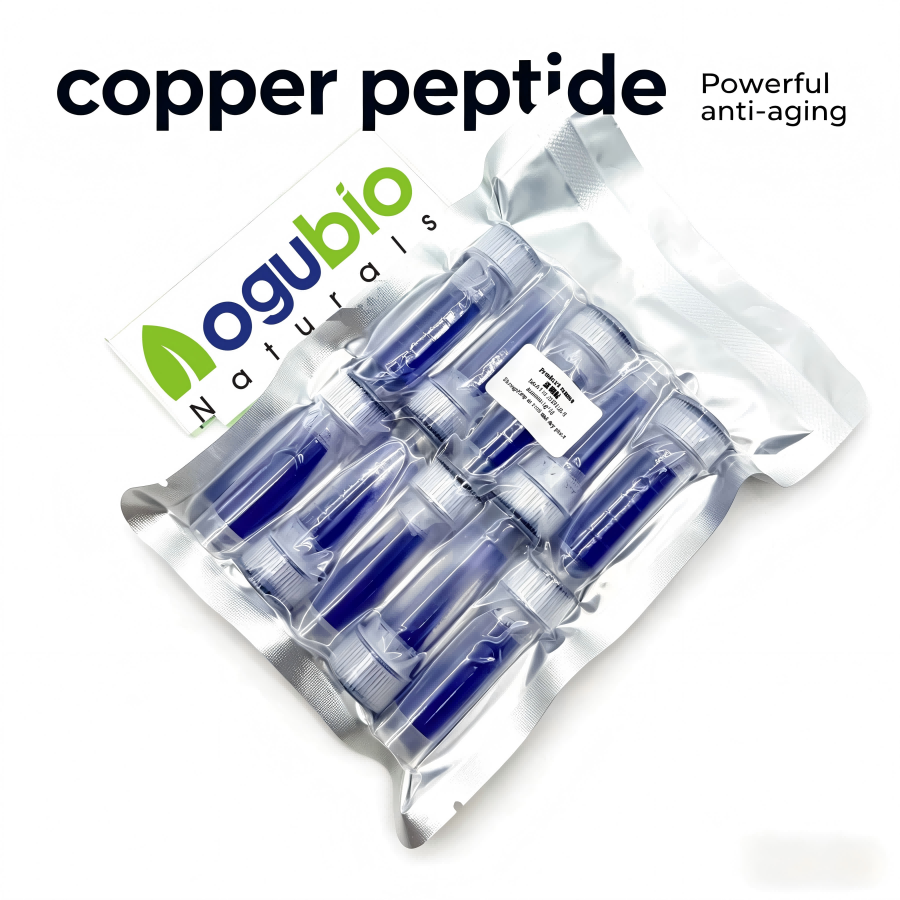
GHK-Cuis a naturally occurring tripeptide complex first isolated from human blood plasma in 1973 by Dr. Loren Pickart. It consists of three amino acids (glycine, histidine, lysine) chelated to a divalent copper ion (Cu²⁺), forming a stable, bioavailable complex with a molecular weight of ~400 Da—small enough to penetrate the stratum corneum and reach dermal fibroblasts. GHK-Cu is present in human plasma, with levels peaking in youth at approximately 200 ng/mL and declining with age to around 80 ng/mL by age 60. Its INCI name is Copper Tripeptide-1 (CAS 49557-75-7), which is widely recognized in global cosmetic regulations. Typically produced via chemical synthesis, it boasts HPLC purity of ≥98% and is free of excess free copper to minimize irritation.
Core Mechanisms of Action
GHK-Cu’s power lies in its ability to orchestrate skin regeneration by modulating key cellular pathways. Unlike ingredients that target single functions such as hydration or antioxidant defense, it acts as a “master regulator” of skin health, addressing multiple aspects of skin aging and repair simultaneously.
- Dermal Remodeling: Collagen & Elastin Synthesis
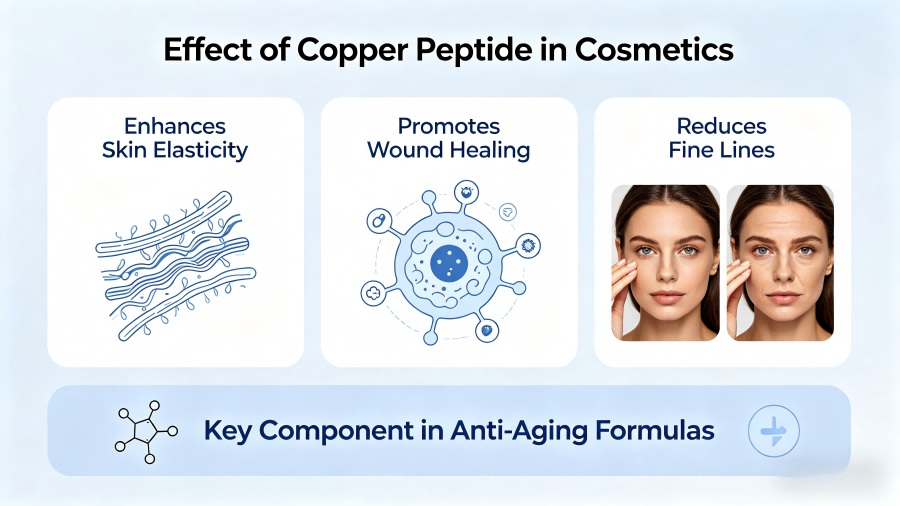
GHK-Cu drives the production of structural proteins critical for skin firmness and elasticity. It upregulates genes encoding collagen types I and III, increasing synthesis by up to 70% in human skin samples; Type I provides the skin’s structural scaffold while Type III supports flexibility and wound healing. It also boosts elastin production, reducing sagging and improving skin resilience. Additionally, GHK-Cu activates lysyl oxidase, a copper-dependent enzyme that cross-links collagen and elastin to ensure their structural integrity—an advantage that sets it apart from other actives that only stimulate production without enhancing structural stability.
- Anti-Inflammatory & Antioxidant Defense
Chronic inflammation and oxidative stress are major drivers of skin aging, and GHK-Cu addresses both effectively. It suppresses pro-inflammatory cytokines including TNF-α, IL-6, and IL-8, while also inhibiting the NF-κB and p38 MAPK pathways to calm redness and sensitivity. On the antioxidant front, it increases the activity of superoxide dismutase (SOD) and catalase, two key enzymes that neutralize free radicals and reduce UV-induced damage. It also scavenges reactive carbonyl species such as 4-hydroxynonenal and inhibits lipid peroxidation, further protecting the skin from oxidative harm.
- Wound Healing & Barrier Repair
GHK-Cu accelerates skin recovery and strengthens the skin’s barrier function. It upregulates MMP-2 and MMP-9, enzymes that clear damaged collagen and promote new tissue growth, shortening healing time by up to 40% in burn patients. For barrier repair, it reduces transepidermal water loss (TEWL) by 58% after 48 hours by stimulating keratinocyte proliferation and increasing the production of barrier proteins such as filaggrin, which helps lock in moisture and protect the skin from external irritants.
- Gene Modulation: A “Reset” for Skin Aging
A landmark study by the Broad Institute found that GHK-Cu modulates 4,192 human genes, which accounts for 31% of the genome. These genes are involved in critical skin functions including regeneration, inflammation regulation, and DNA repair, and GHK-Cu’s ability to “rejuvenate” their expression reverses age-related declines in skin function, effectively turning back the clock on skin aging at a molecular level.
Product Benefits: Why It’s a Game-Changer
- Anti-Aging: Wrinkles, Sagging, & Dullness
GHK-Cu’s primary anti-aging benefit is its ability to reduce fine lines and deep wrinkles by remodeling collagen and elastin, the structural proteins that keep skin firm and smooth. It also improves skin density and thickness, reversing photodamage caused by long-term UV exposure, which often leads to thinning skin and increased wrinkle formation. Additionally, it restores skin radiance by reducing inflammation and oxidative stress, which can leave skin looking dull, tired, or uneven.
- Post-Procedure & Sensitive Skin Care
GHK-Cu is particularly valuable for post-procedure care, as it soothes irritation from treatments such as lasers, microneedling, or chemical peels while accelerating the skin’s natural healing process. Its anti-inflammatory properties also make it ideal for sensitive skin, calming redness and sensitivity in conditions like rosacea and improving overall barrier function to reduce future irritation and discomfort.
- Versatility: Works with Most Actives
One of GHK-Cu’s greatest advantages is its versatility, as it synergizes with many other popular skincare ingredients to enhance overall efficacy. When paired with hyaluronic acid, it enhances moisture retention to plump the skin and reduce the appearance of fine lines. Combining it with niacinamide boosts barrier repair and helps reduce hyperpigmentation, while using it alongside other peptides such as Matrixyl 3000 amplifies anti-wrinkle effects. It also works well with antioxidants like vitamin C to expand free-radical protection and support overall skin health. It is important to note, however, that GHK-Cu should be avoided with strong chelators such as high concentrations of EDTA or products with a pH below 5.0, as these can dissociate the copper-peptide complex and reduce its efficacy.
Cosmetic Applications: Formulation & Use
- Formulation Guidelines
GHK-Cu is highly water-soluble, making it easy to integrate into aqueous formulations; it should be added to the aqueous phase during the cool-down stage (below 40°C) to preserve its activity. Effective concentrations for daily use range from 0.05% to 0.5%, while clinical-grade serums typically use 0.1% to 0.2%. The optimal pH range for formulations containing GHK-Cu is 5.0 to 7.0 (neutral to slightly acidic), as this prevents copper dissociation and maintains the stability of the complex. Packaging is also important—light-resistant, airtight containers such as amber glass or airless pumps are recommended to protect GHK-Cu from light and moisture, which can degrade its activity over time.
- Product Types
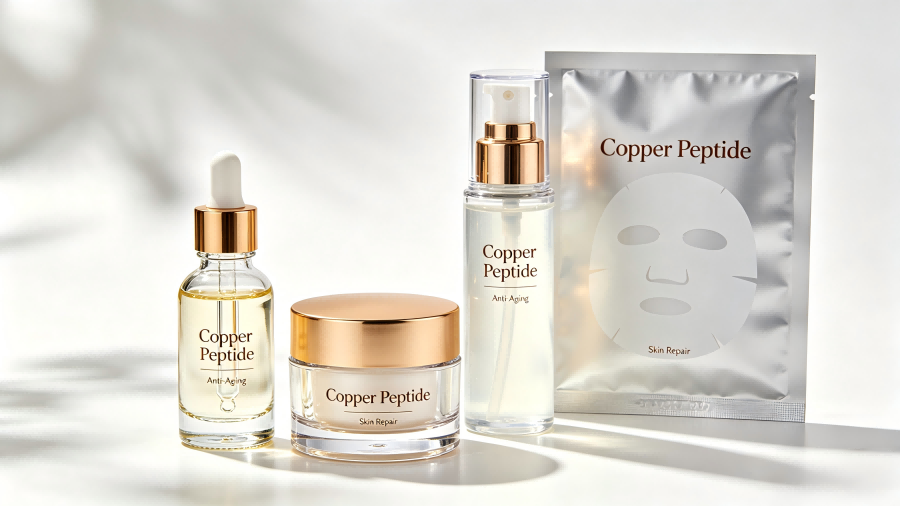
GHK-Cu is integrated into a wide range of skincare products to cater to different needs and preferences. Serums and gels are popular formulations, as they are lightweight and fast-absorbing, making them ideal for targeted anti-aging and repair. Creams and lotions incorporate GHK-Cu into emulsified systems for daily moisturization with added regenerative benefits, suitable for all skin types. Post-procedure products such as gels or creams often feature GHK-Cu to soothe and accelerate healing after laser or microneedling treatments. It is also used in eye care products, where it targets fine lines and dark circles by improving dermal thickness and reducing inflammation around the delicate eye area.
- Safety
GHK-Cu has a well-established safety record for topical use, with mild, transient irritation such as redness or tingling reported in only 5 to 10% of users; these symptoms typically resolve within 24 to 48 hours. Allergic reactions are rare, affecting less than 0.3% of the population, but copper allergy can cause contact dermatitis, so patch testing is recommended for those with sensitive skin. GHK-Cu should be avoided in individuals with Wilson’s disease, a disorder of copper metabolism, or active skin infections. It should also be used cautiously during pregnancy or lactation, as there are no systemic studies to confirm its safety in these populations. The Cosmetic Ingredient Review (CIR) has rated GHK-Cu safe for use at cosmetic concentrations below 150 ppm.
Why It’s Dominating Skincare: The “Triple Win”
GHK-Cu’s dominance in the skincare industry stems from what can be described as a “triple win” of efficacy, gentleness, and versatility. First, its efficacy is backed by robust scientific research and clinical trials, with no overhyped claims—every benefit is supported by data, making it a trusted ingredient for consumers and formulators alike. Second, it is gentle yet powerful, suitable for sensitive skin and daily use, unlike harsher actives such as high-concentration retinol, which can cause irritation and require acclimation. Third, its versatility allows it to be integrated into nearly all product types and to synergize with most other popular skincare ingredients, making it a “must-have” for formulators looking to create effective, multi-benefit products.
Conclusion
Copper peptide (GHK-Cu) is more than a trending ingredient—it’s a scientifically validated solution for modern skincare challenges. From collagen synthesis to barrier repair, its multimodal action addresses the root causes of skin aging, making it a staple in premium and clinical-grade products alike. With strong safety data, global regulatory approval, and proven efficacy across multiple skin concerns, it’s poised to remain a cornerstone of skincare innovation for years to come. As consumers increasingly prioritize science-backed ingredients, GHK-Cu’s role in reshaping the skincare industry is only set to grow.
Name: Yuki
E-mail: sales02@nahanutri.com
WhatsApp:+8618066950297